The Alabama football program’s rigorous training, often detailed in available PDF resources, has become legendary, fueled by Nick Saban’s pursuit of peak athletic performance.
This program emphasizes a blend of strength, conditioning, and mental fortitude, consistently producing championship-caliber athletes and dominating college football.
Historical Context & Nick Saban’s Influence
Nick Saban’s arrival at Alabama in 2007 marked a turning point, instilling a culture of relentless preparation and physical dominance. Prior programs lacked the consistent, scientifically-backed approach Saban demanded, often relying on traditional methods.
He meticulously crafted a system, drawing upon cutting-edge sports science and strength & conditioning principles. PDF documents detailing the program’s evolution reveal a commitment to periodization, focusing on hypertrophy, strength, and power development.
Saban’s influence extends beyond exercise selection; he fostered a mindset of unwavering discipline and accountability. His dedication to the “4th Quarter Conditioning” program, highlighted in numerous reports, demonstrates a focus on mental toughness alongside physical prowess, solidifying Alabama’s dynasty.
Program Philosophy: Strength, Conditioning & Mental Toughness
The Alabama workout program’s core philosophy centers on holistic athlete development, detailed within accessible PDF guides. It’s not merely about building muscle; it’s about forging athletes capable of performing at their peak under immense pressure.
Strength training forms the foundation, emphasizing compound movements to build overall power. Conditioning isn’t limited to sprints; it incorporates varied protocols to simulate the demands of a full game, particularly the grueling “4th Quarter Conditioning”.
Crucially, mental toughness is interwoven throughout. The program aims to break athletes down and rebuild them, fostering resilience and a relentless competitive spirit, mirroring Saban’s own unwavering standards.

Core Principles of the Alabama Football Workout
The Alabama workout, outlined in various PDF documents, prioritizes hypertrophy for foundational strength, intense 4th-quarter conditioning, and individualized training plans.

These principles aim to maximize athlete potential and ensure peak performance.
Hypertrophy Phase: Building a Foundation

The initial six-week hypertrophy phase, frequently detailed within the PDF versions of the Alabama football workout program, is fundamentally focused on substantial muscle mass gain and overall physical strength development.
Specifically designed for incoming athletes – like an 18-year-old Division 1 walk-on – this phase establishes a robust base. It utilizes a structured weight training regimen, emphasizing compound movements to stimulate muscle growth. The program isn’t merely about lifting heavy; it’s about controlled progression and proper form.
This foundational strength is crucial, preparing athletes for the more demanding conditioning and skill-specific training phases that follow. It’s the bedrock upon which peak performance is built, ensuring players can withstand the physical rigors of the season.
4th Quarter Conditioning: Peak Performance Focus
Nick Saban’s renowned “4th Quarter Conditioning” program, often outlined in the Alabama football workout PDFs, prioritizes not only physical endurance but, crucially, mental toughness. This phase is designed to simulate the intense demands of a late-game situation, pushing athletes beyond their perceived limits.
The program aims to build the capacity to perform at a high level even when fatigued, a critical advantage in close contests. It incorporates high-intensity interval training (HIIT) and drills that mimic game-like scenarios, fostering resilience and the ability to maintain focus under pressure.
Success in this phase translates directly to improved performance when facing adversity on the field, a hallmark of Alabama’s championship teams.
Individualized Training: Rhea & Coach Ballous Approach
The Alabama football program, as detailed in circulated PDF workout plans, distinguishes itself through a highly individualized training approach spearheaded by Rhea and Coach Ballous. Recognizing that each athlete possesses unique strengths, weaknesses, and recovery rates, they move beyond a “one-size-fits-all” methodology.
This personalized system involves meticulous assessment and ongoing adjustments to training volume, intensity, and exercise selection. Players receive programs tailored to their specific position, physical profile, and injury history.
Feedback from athletes, like Brian Robinson Jr., highlights the positive impact of this approach, fostering buy-in and maximizing individual potential within the team framework.

Detailed Breakdown of the Workout Components
Alabama’s workout, often found in PDF format, centers on a phased approach: hypertrophy for foundational strength, followed by intense 4th-quarter conditioning for peak performance.
Summer Weight Training Program (4-Week Overview)
The Alabama football summer weight program, frequently circulated as a PDF document, is structured around a progressive four-week plan designed to build a solid foundation before the demands of fall camp. Week one typically focuses on acclimation and higher repetitions with moderate weight, emphasizing proper form and technique.
Weeks two and three progressively increase the weight and decrease the repetitions, shifting towards strength development and hypertrophy. The final week incorporates power exercises and introduces elements of conditioning, preparing athletes for the rigors of the season. This initial phase, often a 6-week hypertrophy phase, prioritizes weight gain and overall physical strength for incoming or developing players.
The PDF often details specific exercises, sets, reps, and rest periods for each day, ensuring a comprehensive and structured approach to summer training.
Strength Training Exercises
Detailed within the Alabama football workout PDFs, strength training forms the cornerstone of player development. The program emphasizes compound lifts, targeting multiple muscle groups simultaneously for maximum efficiency. Core exercises include variations of squats (back, front, goblet), deadlifts (conventional, sumo), bench press (flat, incline, decline), and overhead press.
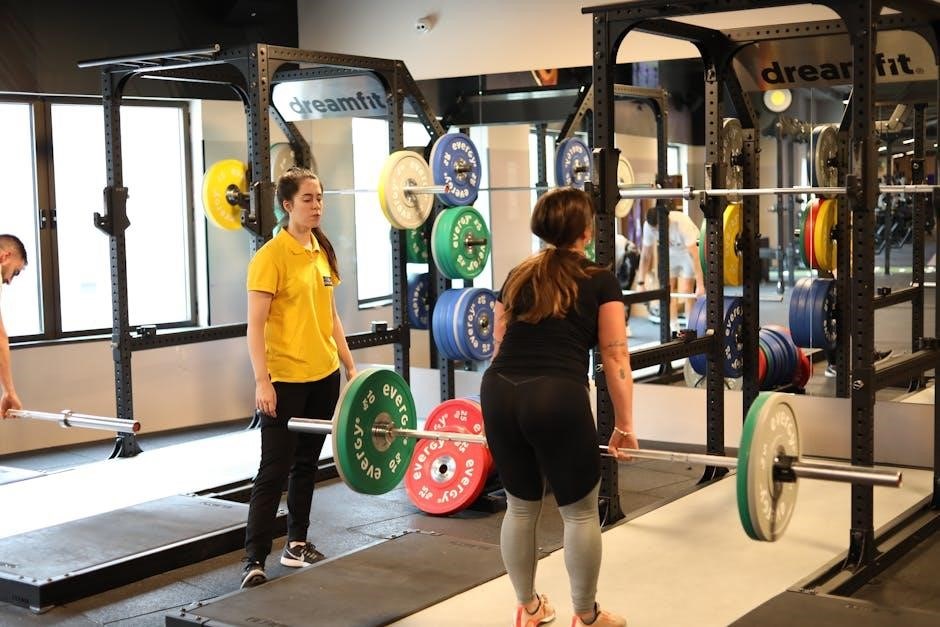
These foundational movements are supplemented with accessory exercises to address specific muscle imbalances and enhance overall strength. The PDFs often prescribe specific set and rep schemes, varying throughout the phases to promote hypertrophy, strength gains, and power development. Proper form and technique are paramount, with a strong emphasis on safety and injury prevention.
The program’s success relies on consistently challenging athletes while prioritizing their well-being.
Upper Body Strength Development
As outlined in the Alabama football workout PDFs, upper body strength is cultivated through a variety of exercises. Bench press variations – flat, incline, and decline – are central, building pectoral, shoulder, and triceps strength. Overhead pressing, utilizing both barbell and dumbbell variations, targets the deltoids and upper chest.
Pulling movements, such as pull-ups, chin-ups, and rows (barbell, dumbbell, cable), are crucial for developing back and biceps strength, promoting balanced muscle development. Accessory exercises, including shoulder raises, bicep curls, and triceps extensions, further refine upper body strength and address individual needs.
The PDFs detail progressive overload principles, ensuring continuous improvement.
Lower Body Strength Development
The Alabama football workout PDFs prioritize lower body strength as foundational for power and athleticism. Squats – back squats, front squats, and goblet squats – are staples, building overall leg strength and core stability. Variations in stance and depth target different muscle groups within the legs.
Deadlifts, including conventional and Romanian deadlifts, are incorporated to develop posterior chain strength – hamstrings, glutes, and lower back. Lunges, both forward and reverse, enhance unilateral strength and balance. Accessory exercises like leg presses, hamstring curls, and calf raises further refine lower body development.

Progressive overload, detailed in the PDFs, is key to continuous gains.
Conditioning Drills
Alabama football workout PDFs reveal a conditioning philosophy centered around “4th Quarter Conditioning,” designed to simulate game-like fatigue and build mental toughness. Shuttle runs, varying in distance and recovery time, improve agility and anaerobic capacity. Hill sprints build explosive power and cardiovascular endurance.
The program incorporates interval training, alternating between high-intensity bursts and periods of active recovery, mirroring the ebb and flow of a football game. Distance running, while present, is strategically implemented to build a base level of aerobic fitness without sacrificing speed or power.
These drills, outlined in the PDFs, aim to prepare athletes for peak performance in crucial game moments.
Speed and Agility Training
Alabama football workout PDFs detail a comprehensive speed and agility program. Cone drills, including the 5-10-5 shuttle, enhance lateral quickness and change-of-direction ability – crucial for all positions. Ladder drills improve footwork, coordination, and reaction time, building a foundation for explosive movements.
Sprints, ranging from short 10-yard bursts to longer 40-yard dashes, develop linear speed and acceleration. Plyometrics, such as box jumps and depth jumps, increase explosive power and improve running mechanics. The PDFs emphasize proper technique and progressive overload to minimize injury risk.
These drills are designed to create fast, agile, and explosive athletes.
Endurance Training Protocols
Alabama football workout PDFs highlight the importance of “4th Quarter Conditioning,” mirroring Nick Saban’s emphasis on peak performance when fatigue sets in. Protocols include varied interval training, combining high-intensity sprints with short recovery periods, building both aerobic and anaerobic capacity.
Distance running, though not the primary focus, is incorporated to build a base level of endurance. Shuttle runs and agility circuits are performed at game speed to simulate the demands of a football game. The PDFs stress maintaining intensity throughout workouts, replicating the late-game fatigue experienced in competition.
This approach cultivates mental and physical toughness, enabling players to excel even when exhausted.

Nutritional Considerations for Alabama Athletes
Alabama workout PDFs don’t extensively detail nutrition, but emphasize fueling intense training with appropriate macronutrient ratios and sufficient caloric intake for recovery.
Macronutrient Ratios & Caloric Intake
While specific Alabama workout PDFs lack precise dietary prescriptions, the program’s demands suggest a high-calorie intake to support intense training and muscle recovery. A macronutrient split likely prioritizes protein – crucial for hypertrophy and repair – potentially around 30-40% of total calories.
Carbohydrates, providing essential energy for workouts and replenishing glycogen stores, likely constitute 40-50%, with healthy fats comprising the remaining 10-20%. Individual caloric needs vary significantly based on position, body weight, and metabolic rate. Athletes likely receive personalized guidance from the team’s nutrition staff to optimize fueling strategies, ensuring they meet the energy demands of the rigorous training regimen and maximize performance gains.
Supplementation Strategies (If Applicable)
Official Alabama workout PDFs generally do not detail specific supplementation protocols, and the program maintains a cautious stance regarding performance-enhancing substances, given past allegations. However, it’s reasonable to assume athletes utilize foundational supplements to support recovery and overall health.
These may include creatine monohydrate for power output, protein powders to aid muscle repair, and vitamin D to optimize bone health and immune function. Electrolyte supplementation is likely emphasized, particularly during intense summer conditioning, to prevent dehydration and cramping. Any supplementation would be closely monitored by the team’s medical staff, adhering to NCAA regulations and prioritizing athlete well-being above all else.
Controversies & Ethical Considerations
Allegations of PED use have shadowed the program, raising ethical questions about competitive advantages, despite a lack of conclusive evidence within Alabama workout PDFs.
PED Allegations & Program Integrity
The specter of performance-enhancing drug (PED) allegations has persistently circled the Alabama football program, fueled by its sustained dominance and the intense physical demands of its training regimen. While publicly available Alabama workout PDFs detail rigorous strength and conditioning protocols, some speculate these are complemented by illicit means.
Critics suggest the program’s ability to consistently recruit and develop exceptionally large and athletic players points to more than just superior coaching and training. These accusations, however, remain largely unsubstantiated, lacking concrete evidence directly linking the program to PED use. Maintaining program integrity is paramount, and the university consistently denies any wrongdoing, emphasizing adherence to NCAA regulations. The debate continues, highlighting the pressures of elite-level competition and the ethical challenges faced by college athletics.
Comparison to Other Top Programs
Analyzing the Alabama workout PDFs reveals similarities and differences when contrasted with strength and conditioning programs at other elite college football institutions. Many top teams employ hypertrophy phases focused on building mass, mirroring Alabama’s initial approach. However, the intensity and specificity of Alabama’s “4th Quarter Conditioning” appear particularly emphasized, aiming for peak performance under fatigue.
While core principles like individualized training – as championed by Rhea and Coach Ballous – are common, the degree of personalization and data-driven adjustments may vary. Some programs prioritize speed and agility more heavily, while others focus on raw strength. Ultimately, success isn’t solely determined by the workout itself, but by coaching, player buy-in, and effective implementation.
Accessing Alabama Workout Resources (PDFs & Online Materials)
Numerous PDF documents detailing Alabama’s football workouts are available online, offering insights into their training methodologies and program structure for interested parties.
Finding Official Alabama Football Workout PDFs
Locating official Alabama football workout PDFs can be challenging, as the program doesn’t widely publicize its most current, internal documents. However, several sources offer glimpses into their training regimens. Online searches frequently yield older workout plans, such as the 4-week summer weight training program, providing a foundational understanding of their approach.
These documents typically outline exercises, sets, reps, and conditioning drills used to build strength and endurance. While not always the latest iteration, they demonstrate the program’s core principles. Fan forums and sports-related websites often host shared PDFs, though verifying their authenticity is crucial. Direct access through the University of Alabama’s athletic website is limited, emphasizing the program’s guarded approach to its competitive edge.
Reliable Online Sources for Information
While official PDFs are scarce, several online platforms offer valuable insights into the Alabama workout program. Sports-focused news sites and forums dedicated to college football often dissect training methodologies, referencing leaked documents or player testimonials. Websites specializing in strength and conditioning may analyze Alabama’s approach based on publicly available information and expert opinions.
YouTube channels featuring former players or strength coaches can provide anecdotal evidence and exercise demonstrations. However, critical evaluation is essential; verify information against multiple sources. Be cautious of websites promising “exclusive” or “complete” programs, as these may be inaccurate or outdated. Reputable sports journalism and academic studies offer the most trustworthy analyses of the program’s success.

Program Adaptations for Different Positions
Alabama’s program, detailed in circulated PDFs, isn’t one-size-fits-all; modifications cater to position-specific demands, optimizing performance for each athlete’s role.
Offensive Line Workout Modifications
As outlined in available PDF documentation of the Alabama football program, offensive linemen receive specialized training prioritizing maximal strength and power development. This involves a heavier emphasis on compound lifts like squats, bench press, and deadlifts, building a robust foundation for blocking assignments.
The PDFs reveal a focus on explosive movements – power cleans and push jerks – to translate strength into functional force on the field. Conditioning drills for this unit differ, concentrating on short bursts and maintaining strength endurance rather than extensive cardio. Specific exercises target core stability and grip strength, crucial for sustaining blocks. The program adapts to individual needs, ensuring linemen are physically prepared for the demanding nature of their positions, as detailed within the training materials.
Defensive Back Workout Modifications
According to the Alabama football program’s PDF training guides, defensive back workouts diverge significantly from those of the offensive line, prioritizing agility, speed, and reactive power. These PDFs detail a program incorporating plyometrics – box jumps, hurdle drills – to enhance explosiveness and change-of-direction ability.
Strength training focuses on functional movements, emphasizing single-leg exercises and rotational power to mimic game-specific actions. Conditioning emphasizes interval training and shuttle runs, building the endurance needed for constant coverage. The program also includes dedicated drills for backpedaling, hip fluidity, and tackling technique. Individualized adjustments, documented within the training materials, cater to specific position requirements – cornerback versus safety – ensuring optimal performance.